
- +8618318065560
- sales@ox-lighting.com

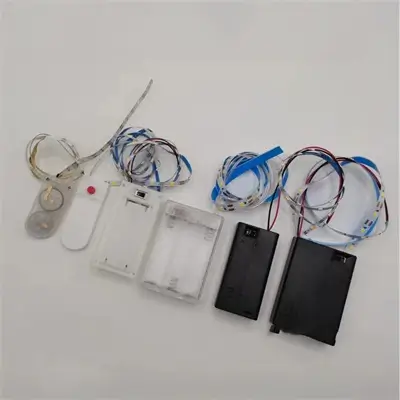
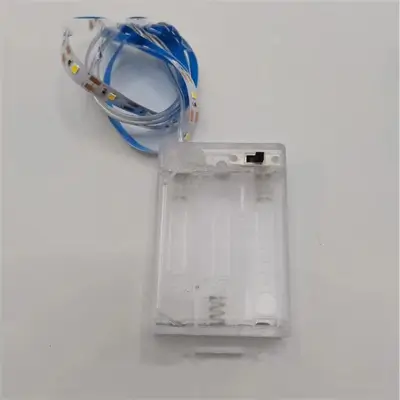
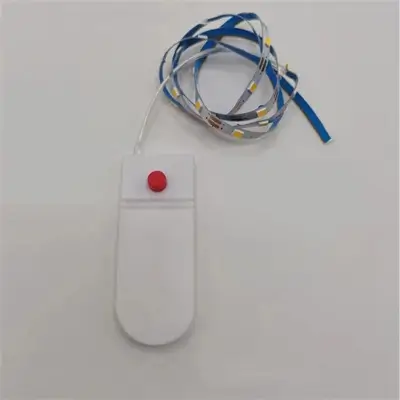
Battery led strip light (aa,aa and rechargeable), Comprehensive Guide to Battery-Powered LED Strip Lights
LED strip lights are flexible, adhesive-backed ribbons of illumination have transformed design, functionality, and ambiance in homes, businesses, and creative projects.
However, battery-powered LED strip lights offers a unique blend of all the advantages of LEDs with the unparalleled benefit of freedom from the nearest wall outlet.
This comprehensive guide explores the world of battery-powered LED strip lights, delving into their history, core components, diverse types, myriad applications, and the technical considerations necessary for successful implementation.
To understand the battery-powered variant, we must first appreciate the foundation: the LED strip light itself.
An LED strip is a marvel of miniaturized electronic engineering. The core components include:
1. Flexible Printed Circuit Board (PCB): This is the “strip” or “ribbon” itself, typically a thin, flexible copper layer with positive (+) and negative (-) traces that serve as conductors.
2. Surface-Mount Device (SMD) LEDs: The light sources, mounted strategically along the PCB. Common sizes include 3528, 5050 (often used for RGB/higher power),
and the more modern 2835. The density (LEDs per meter) dictates the overall brightness and evenness of the light.
3. Resistors: Crucial tiny components placed in series with the LEDs. They **limit the electrical current** flowing to the LEDs, protecting them from burnout
and ensuring a consistent and optimal brightness.
4. Cut Points: Marked sections on the PCB where the strip can be safely cut to length without damaging the circuit.
Each segment typically contains a small group of LEDs and a resistor (e.g., three LEDs and one resistor for a 12V strip).
5. Adhesive Backing: A strip of strong double-sided tape (often 3M brand) on the underside for easy, non-permanent mounting.
Core Components of a Battery System,Moving away from the traditional wall-plug power supply (AC-to-DC driver), a battery setup requires careful matching of components.
1. The Battery Pack: The power source, providing the low-voltage Direct Current (DC) required by the LEDs.
Common Types:
Standard Cells (AA/AAA): Often used in a battery box (holder) where multiple 1.5V cells are wired in series to achieve the necessary voltage
(e.g., eight 1.5V AA cells in series to create 12V).
Lithium-Ion (Li-ion) Packs: The preferred choice for professional and high-performance applications. They offer superior energy density
(more power in a smaller, lighter package), consistent voltage output, and are usually rechargeable.
Specialized LiFePO4: Used for high-cycle industrial applications due to their safety and long lifespan.
2. Controller/Driver: While wall-plug strips use a driver to convert AC to DC, battery strips need a controller for dimming, color change (for RGB/RGBW strips),
and sometimes motion sensing. Some battery packs have an integrated voltage regulator.
3. Connection Method: Typically, a DC barrel jack connector is used to plug the battery pack directly into the LED strip’s input. Bare wire terminals are also common,
requiring simple soldering or clamp connectors.
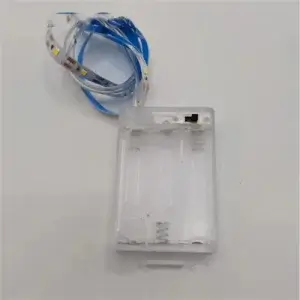
The single most important rule when pairing a battery to an LED strip is Voltage Compatibility.
Voltage: LED strips are commonly manufactured to run on 5V, 12V, or 24V DC. The battery’s output voltage must match the strip’s operating voltage.
Using a higher voltage will instantly damage the LEDs, while a lower voltage will result in dim or non-existent light.
Capacity (Runtime): This determines how long the strip will stay lit and is measured in milliamp-hours (mAh) or Watt-hours (Wh).
Calculation of Runtime: The total power draw of the LED strip (measured in Watts) is compared against the battery’s energy capacity (Wh).
For example, a 78Wh battery powering a 20W LED strip will run for approximately 3.9 hours. Designers often use a dimmer or shorter strip to extend this runtime.
Types of Battery LED Strips
Single Color (White) Provides a uniform white light. Available in different Color Temperatures (CCT), from warm white (2700K–3000K) to cool white (4000K–6000K).
Task lighting (under cabinets), closets, utility spaces.
RGB/RGBW Contains Red, Green, and Blue diodes (and White for RGBW) that can be mixed to create millions of colors. Requires a dedicated controller.
Mood lighting, decorative displays, themed events, set design.
COB (Chip-on-Board) Features an extremely high density of tiny LEDs, resulting in a perfectly smooth, dot-free line of light.
Architectural accents where a seamless light line is required (e.g., outlining shelves).
Waterproof (IP Rated) Coated with a protective layer (silicone or epoxy) to resist moisture and dust, typically rated IP65 or higher.
Outdoor use, bathrooms, areas prone to splashing.
Motion-Sensor Includes a PIR (Passive Infrared) sensor, automatically turning the light on when motion is detected and off after a set delay.
Wardrobes, staircases, emergency pathway lighting.
The freedom from a wall socket makes battery strips ideal for situations demanding temporary, mobile, or remote illumination.
Home and Interior:
Closets and Cabinets: Instant, automatic lighting inside storage spaces where wiring is difficult.
Under-Bed Lighting: Used with motion sensors to provide soft path lighting at night.
Shelf and Display Case Lighting: Highlighting collections or products without visible cables.
Outdoor and Events:
Camping and Hiking: Lightweight, portable light for tents, canopies, and temporary trail marking.
Event and Party Decor: Temporary lighting for gazebos, tables, or signage at weddings, festivals, or trade show booths.
Costume Design: Incorporating light into clothing and props for parades, theater, or cosplaying.
Utility and Emergency:
Sheds and Garages: Illumination in structures without easy access to electrical wiring.
Emergency Lighting: Providing a temporary light source during power outages.
Like any technology, battery-powered LED strip lights come with a specific set of pros and cons, which must be weighed against the project requirements.
Advantages (Pros)
Ultimate Portability and Flexibility: They can be placed literally anywhere without outlets.
Easy, Non-Destructive Installation: The self-adhesive backing and lack of complex wiring make installation simple.
Safety (Low-Voltage DC): Operating on low-voltage DC power (5V, 12V, or 24V)
Energy Efficiency: LEDs require very little power, working long time
Disadvantages (Cons)
Limited Runtime: Battery can not work for long time
Brightness Limitations: battery strips are often lower power than their plug-in counterparts.
Cost of Batteries/Rechargeable Packs: rechargeable lithium packs can be exta more cost
Voltage Drop over Length: long led strips runs will still experience a slight dimming effect towards the end of the strip due to resistance in the PCB traces.
Name | Battery led strip |
SMD | 2835LEDS 5050 LEDS |
Voltage | 3V 4.5 5V 6V 9V(V) |
LED Qty | 5050 30leds, 2835 60leds per meter |
PCB | 2mm,3mm,3.5mm,5mm,6mm,8mm,10mm,12mm,15mm,20mm |
Color | red/blue/green/white /warm white |
Lumen | 22lm/leds |
Battery | AA Battery or C2032 battery |
Pacakge | 1pcs/plastic bag |

 English
  Italiano
  Español
  Deutsch
  Nederlands
  Português
  Français